
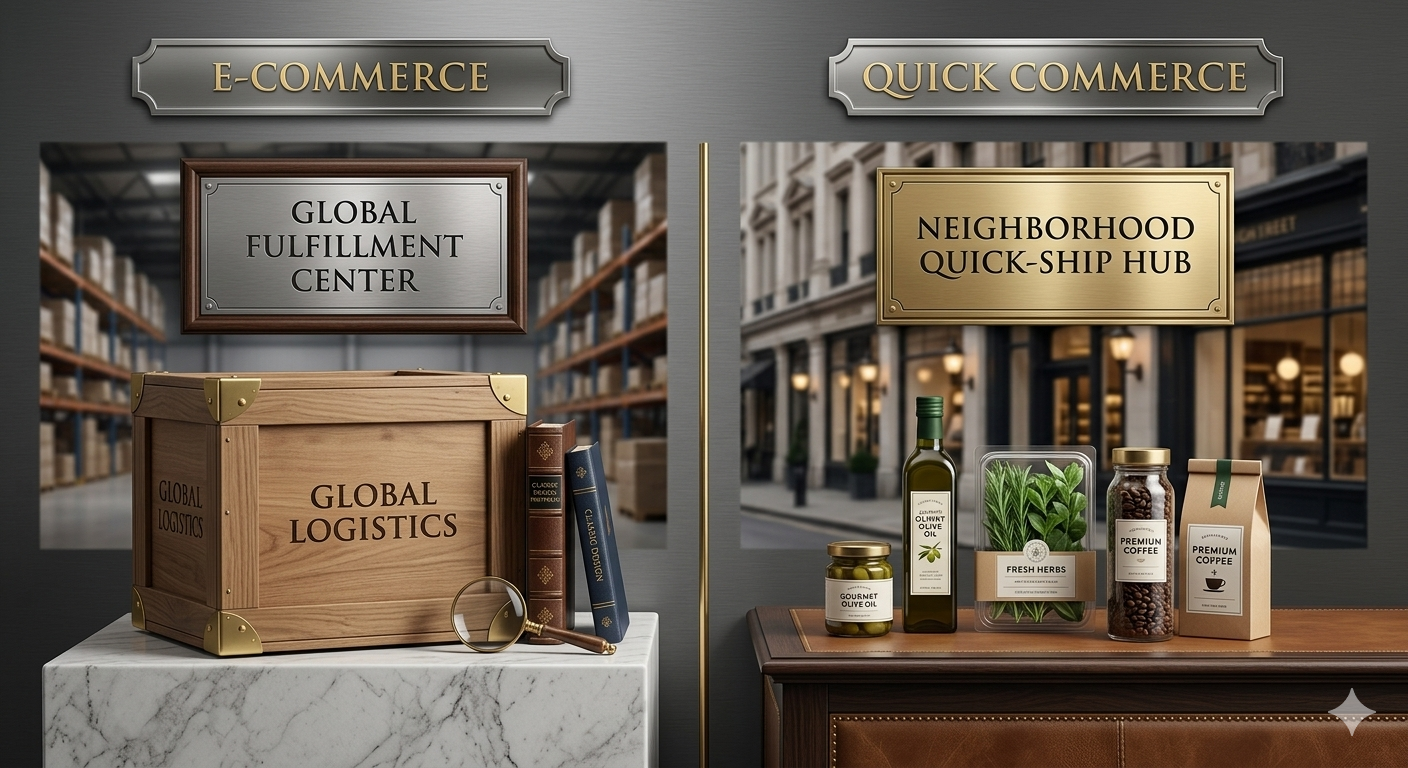
The way people shop has never evolved faster than it is evolving right now. Two distinct models are competing for consumer attention, brand investment, and market dominance — and the conversation around e-commerce vs. quick commerce has moved well beyond industry jargon into boardroom strategy. Sellers who are actively refining their Amazon Brand Store Strategies already understand that the rules of digital retail are being rewritten at speed. Whether you are a brand, a seller, or a marketer, understanding the fundamental differences — and surprising overlaps — between these two models is no longer optional. It is a competitive necessity.
Defining the Two Models
E-commerce, in its conventional form, is the practice of buying and selling products online with delivery windows typically ranging from next-day to several days. Giants like Amazon, eBay, and Walmart built their digital empires on this foundation — offering enormous product catalogues, competitive pricing, and logistics networks that gave consumers both choice and reliability at scale.
Quick commerce — commonly called q-commerce — operates on an entirely different philosophy. Platforms in this space have conditioned modern consumers to expect everyday essentials delivered in under 15 to 30 minutes. Speed is not a feature here; it is the entire business model. When you hold e-commerce vs. quick commerce up against each other, the defining contrast becomes clear: one is built on breadth, selection, and price — the other is engineered purely around immediacy.
The Consumer Psychology Behind the Split
Today’s consumers are not choosing between these two models — they are actively using both, but for very different reasons. The buying decision has become intensely contextual. Someone researching a new laptop, a winter jacket, or a piece of furniture will gravitate toward a traditional e-commerce platform — they want comparison tools, detailed reviews, and flexible return policies. That is a considered, time-invested purchase.
But the same person who spent 40 minutes browsing e-commerce for running shoes will spend exactly four seconds ordering bottled water or a snack from a q-commerce app without a second thought. This is the psychological core of the e-commerce vs. quick commerce debate. One model satisfies planned demand; the other captures unplanned, urgent, or habitual need. They are not the same transaction, and they are not competing for the same moment in a consumer’s day.
Category Ownership: Where Each Model Dominates
Understanding category fit is perhaps the most commercially important insight in the e-commerce vs. quick commerce conversation for any brand or seller.
Traditional e-commerce has a firm grip on electronics, fashion, home furnishings, books, beauty, and any product where the consumer wants to browse extensively before committing. High-consideration purchases require the infrastructure of detailed product pages, image galleries, size guides, and review ecosystems — all things that mature e-commerce platforms have perfected over decades.
Quick commerce owns the daily essentials space: packaged foods, beverages, household supplies, personal care products, and over-the-counter health items. Purchase frequency in this space is exceptionally high even if individual basket sizes remain modest. For consumer goods brands in particular, absence from q-commerce platforms is no longer a passive choice — it is an active concession of market share to competitors who are present.
The Economics: A Necessary Reality Check
The business model economics sitting beneath the e-commerce vs. quick commerce debate are sharply different and worth understanding clearly.
Traditional e-commerce benefits from decades of supply chain optimisation, centralised fulfilment centres, and enormous economies of scale. The cost per order on a mature e-commerce platform is the product of years of infrastructure investment and operational refinement.
Quick commerce runs on a fundamentally more expensive structure. Hyperlocal dark stores — small, strategically positioned micro-warehouses built close to dense population centres — require significant capital to establish and operate. Rapid delivery riders completing multiple short runs per hour are operationally intensive. Most q-commerce businesses are still working toward sustainable unit economics, which means commission structures and promotional costs for sellers on these platforms can differ substantially from traditional channels. Brands must build this into their margin modelling before committing inventory and spend.
Building a Strategy That Works Across Both
The critical mistake many brands make when confronting the e-commerce vs. quick commerce landscape is treating it as a binary choice. It is not. The smartest brands are building deliberate, differentiated strategies for each channel — recognising that the same product may need entirely different content, pack sizes, promotional mechanics, and pricing architecture depending on where it is being sold.
On traditional e-commerce, brand equity is built through content richness: compelling product descriptions, premium imagery, A+ pages, and consistent review management. Visibility is earned through SEO, sponsored placements, and catalogue integrity. On quick commerce platforms, winning is about real-time availability, category positioning, and capitalising on high-traffic promotional slots. These are different disciplines, and conflating them leads to underperformance on both.
What Comes Next: Collision or Coexistence?
The most compelling question in the evolving e-commerce vs. quick commerce narrative is whether these two models will eventually merge into one. The signals are already appearing. Major e-commerce platforms are investing heavily in faster last-mile delivery. Simultaneously, leading q-commerce players are expanding their category range well beyond groceries into electronics, beauty, and lifestyle products — territory that once belonged exclusively to traditional platforms.
The lines are blurring rapidly. What started as two clearly separate roads is becoming an overlapping, increasingly competitive space. The e-commerce vs. quick commerce dynamic, whatever form it eventually takes, is driving the entire retail industry toward a single outcome: higher expectations from consumers and higher standards from the brands that serve them.
Conclusion
The e-commerce vs. quick commerce conversation reflects something deeper than a technology shift — it reflects a fundamental change in what consumers expect from the brands they buy from. Availability, speed, trust, and relevance are now table stakes across every channel.
The brands that will lead in this environment are not the ones who pick a favourite platform and commit to it exclusively. They are the ones building channel-agnostic brand strength, operationally flexible supply chains, and data-informed strategies that meet consumers wherever they are — and whenever they need something.
At Dream Grow Digital, we specialise in helping brands build exactly that kind of multi-channel presence — translating complex commerce dynamics into clear, executable growth strategies that perform across every platform that matters.

The breakdown of e-commerce vs. quick commerce really highlights how consumer expectations are shifting faster than most brands can adapt. It’s fascinating to see how q-commerce is redefining speed as a core competitive advantage, especially for everyday essentials. This evolution isn’t just about delivery time—it’s about rethinking the entire customer journey and logistics strategy.
The comparison really highlights how speed has become a core differentiator in modern retail. Brands that can successfully combine the scale of traditional e-commerce with the immediacy of q-commerce might be the ones leading the next wave of consumer expectations.
I’ve been tracking this divergence closely, and your point about speed acting as the entire business model for q-commerce is spot on. It’s fascinating to see how the demand for instant gratification is effectively forcing brands to rethink their traditional logistics and inventory placement.
При выводе из запоя на дому с быстрым облегчением используются различные медикаменты, направленные на быстрое восстановление водно-солевого баланса, улучшение функции печени и почек, а также снижение симптомов алкогольного абстинентного синдрома. Важно, что состав препаратов подбирается в зависимости от состояния пациента, и все препараты вводятся под контролем квалифицированного медицинского специалиста.
Углубиться в тему – https://vyvod-iz-zapoya-na-domu-ekaterinburg-19.ru
Капельница от похмелья с контролем врача в Самаре представляет собой эффективную терапевтическую процедуру, позволяющую значительно улучшить самочувствие пациента за короткий срок. Врач, контролируя весь процесс, может точно определить, какие компоненты необходимы для каждого пациента. Состав капельницы зависит от симптомов похмелья, состояния пациента и его индивидуальных потребностей. Это позволяет обеспечить максимально безопасное и эффективное лечение, которое помогает организму быстро восстановиться.
Детальнее – капельница от похмелья анонимно самара
Выбор между домашней помощью и стационарным лечением определяется не удобством, а медицинской целесообразностью. В условиях клиники исключаются внешние триггеры, обеспечивается изоляция от источников алкоголя и создается контролируемая среда, где терапевтические решения принимаются на основе объективных показателей, а не субъективных ощущений пациента. Такой подход критически важен для предотвращения осложнений, минимизации дискомфорта абстиненции и формирования устойчивой базы для дальнейшей противорецидивной работы.
Углубиться в тему – http://www.domen.ru
В Нижнем Новгороде выезд нарколога на дом используется при состояниях, требующих оперативной медицинской оценки и начала терапии. Врач приезжает с необходимыми препаратами, проводит осмотр и формирует план лечения на месте. Такой формат позволяет сократить время до начала помощи и снизить нагрузку на пациента.
Получить больше информации – круглосуточная наркологическая помощь нижний новгород